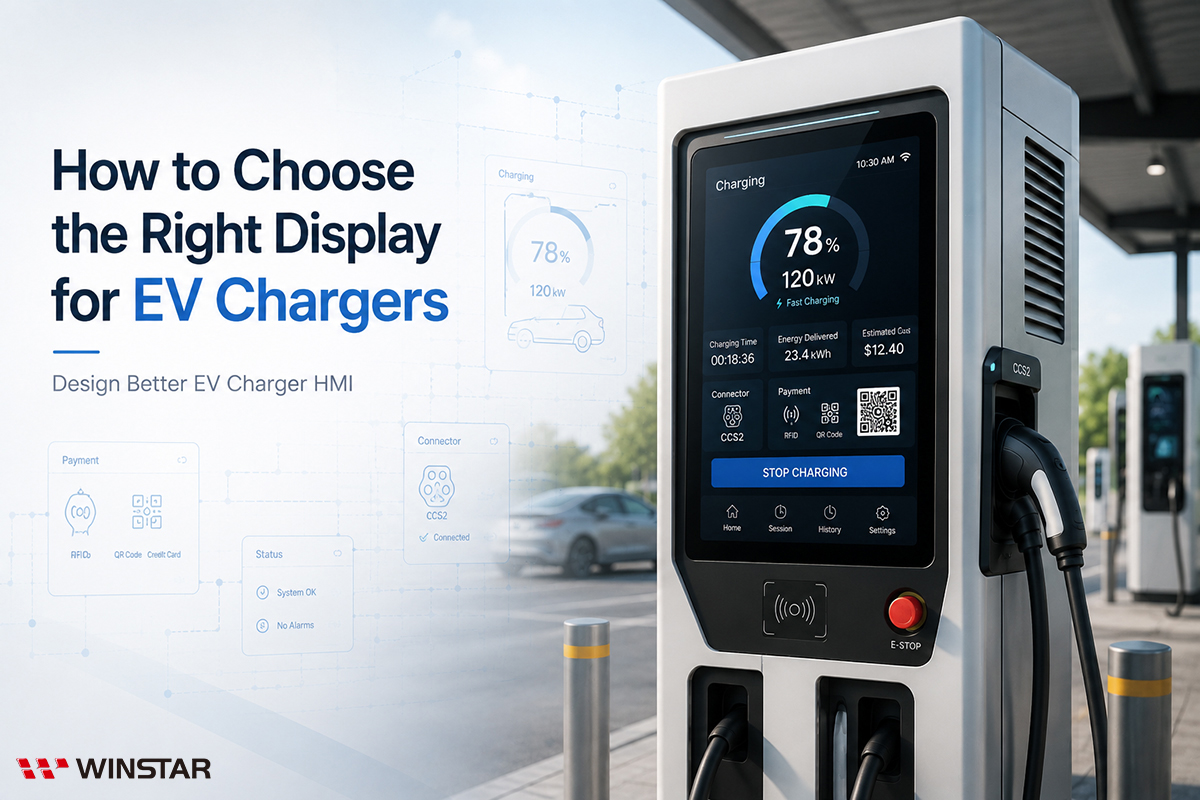
The human-machine interface is where every EV charging station interaction happens — checking charging progress, following on-screen instructions, making a payment or responding to a system notification. As charging infrastructure continues to evolve, display selection has become central to usability, operational efficiency and the overall charging experience.
This featured guide from Winstar looks at the key considerations for EV charger HMI design: sizing and resolving the display around the UI workflow rather than the front panel alone, environmental adaptability for indoor, semi-outdoor and fully exposed installations, touch interaction technologies including projected capacitive touch, glove operation and water rejection, system architecture choices between standard TFT display modules and integrated Smart Display solutions, and the long-term reliability and lifecycle planning that continuous, unattended operation demands.
For engineers specifying displays for residential AC, commercial AC or DC fast charging stations, it provides a practical framework for balancing readability, touch performance, integration effort and total cost of ownership.